




Motor Grader Snow Blades: Choosing a Cutting Edge That Survives Grading Duty
A county garage swapping a grader edge before a February storm knows the pattern: the center of the old edge is ground thin, the corners are still sharp, and the machine has been scraping…
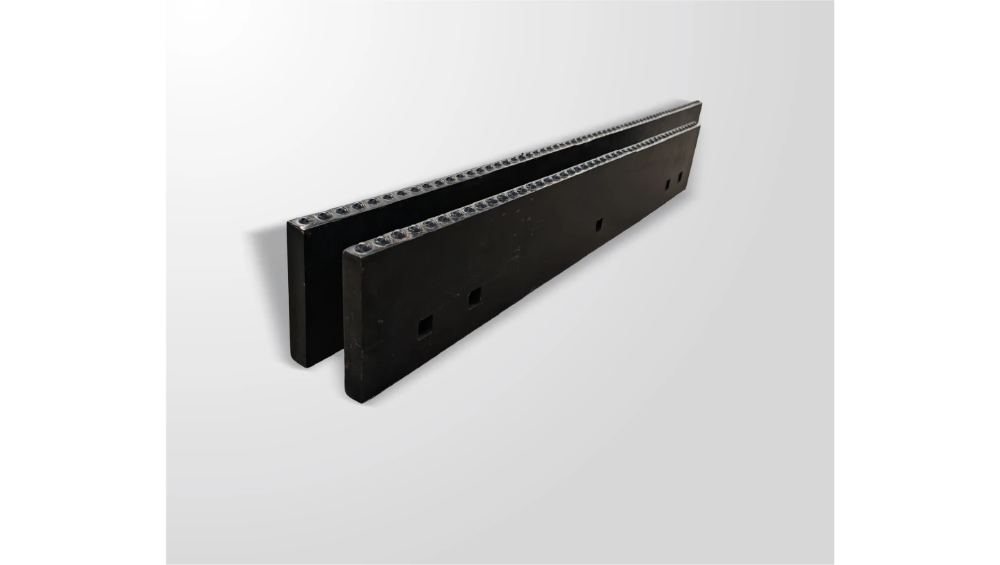
A county garage swapping a grader edge before a February storm knows the pattern: the center of the old edge is ground thin, the corners are still sharp, and the machine has been scraping packed ice on bridge approaches all month. Grader snow blades live under enormous down-force and run across everything from packed ice to washboard gravel, so their edges wear in patterns that are diagnosable — and preventable.
What a Grader Snow Blade Does Differently
The blade carries the machine’s weight through the moldboard, so the edge operates under far higher pressure than a truck plow edge — useful for cutting hard-packed snow, but it multiplies wear and turns every obstacle into an impact event. Grader work also covers wide surfaces at variable angles: the blade cuts across the road, drags material to the shoulder, and lifts over obstacles, so the edge is scraped, dragged, and struck — three wear modes on one tool.
Carbide vs Steel Edges for Grader Duty
| Factor | Steel edge | Carbide edge |
|---|---|---|
| Initial cost | Lower | Higher |
| Wear life under continuous abrasion | Baseline | Substantially longer when grade is matched |
| Impact behavior | Bends, dents, repairable | Can chip or lose inserts on severe impacts |
| Downtime | More changeouts | Fewer, if the grade fits the route |
| Best fit | Light grading, low mileage | Gravel, ice, and high-utilization fleets |
The deciding question is whether the grader spends more hours scraping abrasive material or hitting hard objects. A county grader maintaining gravel roads will favor carbide; a grader doing demolition-adjacent work may chip it out before the wear life is reached.
Matching the Grade and Profile to the Job
Two specifications matter beyond the edge length and hole pattern:
Carbide grade. Harder grades resist abrasion but chip on impact; tougher grades survive impacts but wear faster on gravel. The route decides which direction to lean, and a supplier should ask about your material before quoting a grade.
Edge profile. A square edge scrapes flat and is standard for winter. A beveled profile cuts into packed snow more aggressively but wears faster and is more sensitive to angle. Match the profile to the ice thickness you actually face.
The Failure Modes Graders Expose
Grader duty exposes edge weaknesses quickly:
- Chipped inserts on gravel shoulders and bridge approaches, when the grade is too hard for the impact load
- Worn-through centers when down-pressure is excessive or the moldboard is slightly bowed
- Bolt shear when the hole pattern is mismatched or torque is wrong — a grader’s vibration finds every loose bolt
- Corner rounding when the blade runs at a steep angle for long stretches
These are setup and selection problems, not evidence that carbide is the wrong material. The wear diagnosis guide in this series has the symptom-to-action table; the installation guide covers torque and mounting.
Reading Grader Wear Patterns
| Wear pattern | Likely cause | Action |
|---|---|---|
| Center wears faster than ends | Excessive down-force, bowed moldboard, or crown concentration | Reduce pressure, check moldboard straightness |
| One corner worn | Extreme blade angle or shoulder contact | Adjust angle, rotate the edge |
| Chipped inserts | Grade too hard for impact, or obstacle strike | Move to a tougher grade |
| Rounded profile | Blade run too flat, or a dull edge pressed harder | Correct angle, replace the edge |
The center-wear pattern is the one grader operators see most: the blade carries the load mid-span and the ends lift on the crown. Read the pattern before buying a different grade — if it is a pressure or moldboard problem, no grade fixes it.
What to Send a Grader Edge Supplier
Send the grader model and moldboard length, the current edge’s hole pattern and thickness, a photo with a scale, and your dominant surface — gravel, chip seal, ice, or mixed. SENTHAI builds carbide cutting edges for graders and plows from OEM drawings at its Rayong, Thailand factory, and can discuss grade and profile options for winter duty. These are selection guidelines, not life guarantees — results depend on surface, down-force, and setup, so validate the choice on your routes.
FAQ
Can one cutting edge handle both summer grading and winter snow?
Often, but not optimally. Summer gravel grading is continuous abrasion; winter snow work adds ice and impact. If the grader does both, expect the edge to be a compromise — or change edges seasonally.
Why does the center of a grader edge wear faster than the ends?
The blade carries the load mid-span and the ends lift over the road crown, concentrating contact in the center. Check down-force and moldboard straightness first — if the pattern returns on a new edge, it is a setup problem, not a material one.
How often should grader cutting edges be rotated?
Rotate when the wear pattern shows a taper — usually mid-season for high-utilization graders. The tracking template in the wear guide tells you when the taper is real versus imagined.
Related
- What Are Grader Blades and How Do They Enhance Road Maintenance Efficiency?
- Winter Road Maintenance Wear Parts — fleet-level wear-part strategy
- How to Reduce Snow Plow Blade Wear — symptom-to-action diagnosis
Sources
- SENTHAI – What Are Grader Blades and How Do They Enhance Road Maintenance Efficiency?
- SENTHAI – How Can Data-Driven Grader Blade Selection Reduce Downtime and Costs?
- Clear Roads – Winter Maintenance Research
- AASHTO – American Association of State Highway and Transportation Officials
- ASTM International – Wear Testing of Cemented Carbides
Related articles
 Best Snow Plow Blade Family for Your Fleet: Top 5 ScenariosKnowledge
 Top 10 Snow Plow Blade Types for Winter Fleets (Ranked by Duty Fit)Knowledge
 Top 5 Best Carbide Blade Configurations for Highway PlowingKnowledge
 Best Snow Plow Blade Materials Ranked: Steel vs Carbide vs Cladding vs Rubber-CarbideKnowledge