




Comprehensive Procurement Guide to Municipal Snow Plow Solutions: Optimizing Total Cost of Ownership and Fleet Efficiency
Municipal snow plow procurement is shifting from low-bid unit price to total cost of ownership (TCO): carbide insert cutting edges with documented material integrity, AASHTO-standard hole geometry, and manufacturing scale keep routes open with…

Municipal snow plow procurement is shifting from low-bid unit price to total cost of ownership (TCO): carbide insert cutting edges with documented material integrity, AASHTO-standard hole geometry, and manufacturing scale keep routes open with fewer mid-storm failures. The financial and operational impact of a mid-storm edge failure justifies specification-driven sourcing.
(Last modified date: August 31, 2026)
Key Takeaways
- TCO, not unit price, determines true winter fleet cost — labor, downtime, and route risk included.
- Carbide insert edges are widely specified for heavy-abrasion municipal routes.
- AASHTO-standard bolt patterns and CNC-controlled hole geometry cut maintenance overhead.
- High-control manufacturing reduces mid-storm failure risk versus broker models.
Total Cost of Ownership Over Price in Winter Operations
Selecting a low-bid cutting edge without strict quality controls creates disproportionate downstream costs. When mounting hole tolerances drift or steel backing plates deform, crews face extended installation delays, stripped hardware, and premature failure during severe weather. True operational efficiency is determined by TCO: initial purchase price plus mid-season replacement labor, truck downtime, and the broader risk of leaving routes underserved during freeze-thaw cycles. See JOMA systems: performance, lifespan, and cost control.
| Operational Metric | Low-Control Broker Model | High-Control Manufacturing Model |
|---|---|---|
| Bolt hole accuracy | Variable, manual punching | CNC-controlled, standardized |
| Material consistency | Mixed or reclaimed grades | Verified, batch-traceable |
| Delivery reliability | Logistics intermediaries | Direct factory capacity |
| Mid-storm failure risk | High | Low, predictable wear |
| Overall TCO impact | Hidden labor, emergency reorders | Stable cost per mile |
Material Integrity and the Science of Tungsten Carbide Inserts
Carbide insert cutting edges are widely specified for heavy-abrasion municipal routes. The science comes down to grain size, binder content, sintering, and bonding: micro-grain grades balance wear resistance and impact toughness, vacuum sintering removes porosity, and controlled brazing keeps inserts seated. Batch traceability lets agencies verify chemistry and test data. See washer nuts and carbide wear part durability.
AASHTO Standardization and Hole Geometry Accuracy
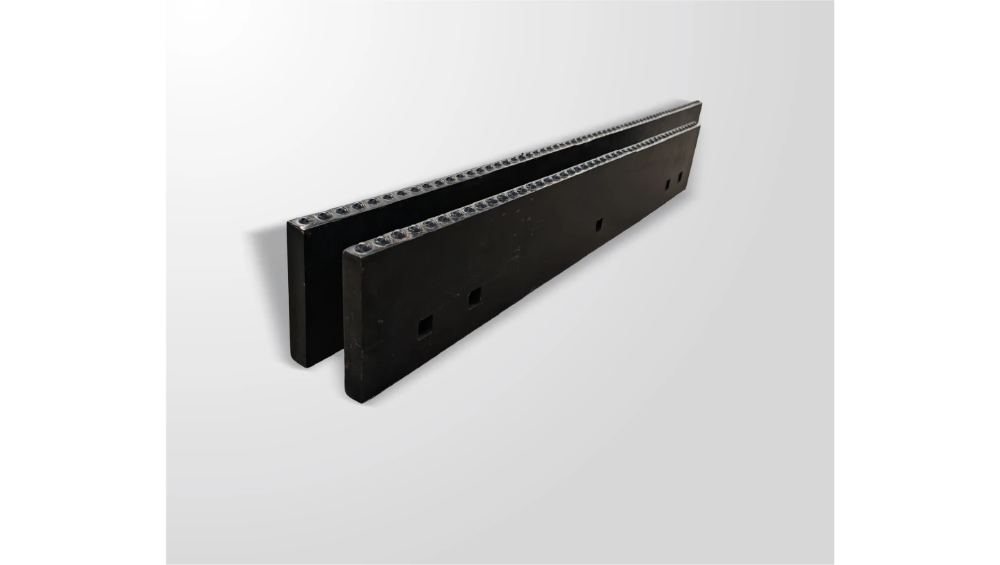
Standardized AASHTO bolt patterns reduce fleet maintenance overhead by allowing one blade to fit multiple moldboards. CNC-controlled hole punching keeps end offsets, spacing, and countersinks within tolerance, so changeouts go fast even across mixed fleets.
Technical Specifications for Municipal RFQs
- Carbide grade, grain size, and hardness per batch.
- AASHTO hole pattern and centerline tolerance.
- Brazing and bonding test data.
- TCO and cost-per-mile reporting.
- Delivery and seasonal stocking commitments.
Comparing Municipal Cutting Edge Alternatives
| Edge Type | Wear Life | Impact Tolerance | Best For |
|---|---|---|---|
| Steel | Short | Good | Light routes |
| Carbide insert | Long | Good with grade tuning | Abrasive municipal routes |
| I.C.E. isolated | Long | Excellent | Impact-heavy roads |
Aligning Blade Configurations with Winter Operations
Front plows need long-wear carbide edges; underbody scrapers need impact-tolerant configurations; wing plows need flexible segments. Match architecture to route and position for the best balance. See how dump truck plows enhance winter maintenance.
Manufacturing Scale and Supply Chain Resilience
Direct factory production with automated lines and seasonal capacity planning keeps deliveries on time before storms. Batch traceability and ISO certification support tender compliance.
Frequently Asked Questions
What technical factors should municipal DOTs prioritize?
Material integrity, AASHTO hole geometry, bonding quality, batch traceability, and TCO documentation.
How do standardized AASHTO bolt patterns reduce overhead?
One pattern fits multiple moldboards, simplifying inventory and speeding changeouts across mixed fleets.
How can departments calculate TCO for cutting edges?
Include purchase price, replacement labor, downtime, route risk, and fuel impact; track cost per mile.
Are carbide insert blades suitable for underbody and wing plows?
Yes — with architecture matched to position: impact-tolerant for underbody, flexible segments for wings.
Related Articles
Official Resources
- SENTHAI — Carbide Snow Plow Blades
- SENTHAI — Replaceable Carbide Inserts
- SENTHAI — Contact for Municipal RFQs
References
- Municipal procurement best practices for winter wear parts, 2025–2026.
- SENTHAI manufacturing and TCO documentation.
Related articles
 Carbide Corrosion Resistance: Complete Guide to Materials, Grades, and Real-World Performance2026
 Snow Plow Carbide Blades: Durability, Performance, and Market Evolution2026
 Sustainable Road Carbide Solutions For Greener, Longer-Lasting Highways2026Superior Carbide Bonding for Snow Plow Blades and Roadwear Parts2026